Showing posts with label Reading & Writing. Show all posts
Thursday Thoughts: Remembering your Reader
Sometimes in the midst of all your coursework, it can feel like
all your writing is made to be read by your classmates on a discussion board.
It becomes easy to assume that this is your most common audience, but as you
move through your academic program, and after graduation, your audience will become
more varied. Perhaps you will be writing for other professional in your field,
or for co-workers, or for the general public in popular publications. Maybe you
will write for people who don’t know a lot about your topic yet, and maybe you
will write for people whose expertise exceeds your own. Whatever your audience
may be, it will have more variety than your classmates, and it will appear in
more places than a discussion board. So how do you consider your audience?

When writers consider their audience, they are able to engage them through appropriate content and word choice. and Knowing that our students will work and write in many fields,
and that the purpose for writing may also shift, we have created resources for
considering the audience:
- Our web page on audience gives an overview of the topic
- On the blog, Nik looks at how he learned to consider his audience and adjust his language and tone.
- We also have a WriteCast episode on audiences.
- How do you know your audience? Amber shares tips for reaching audiences on the blog.
- And if you are thinking of writing for publication, here is how to plan choosing your audience.

The Walden University Writing Center creates content to help students with a range of topics related to scholarly writing, APA style, and the writing process. We host webinars, and offer paper reviews, live chat, and a podcast.
.png)
Never miss a new post; Opt-out at any time
Thursday Thoughts: Time to Reflect
2018 may have felt like the longest year ever to exist, but
it is finally drawing to a close. Because many people like to reflect at the
end of things, the Walden Writing Center is jumping in to share some of our
favorite resources related to reflection.
The art of reflecting is about pausing to look at one’s
self, situation, or work. However, at its best, reflection is also about then determining
what to do next. When you think about your writing over this past year, what
will you seek to improve in 2019? What did you do well and want to continue?

We hope you take some time to reflect and some time to reset
for 2019. To help with your writing reflections, check out these writing center
resources:
- In this blog post, get to know more about reflecting your writing, both individual assignments and your entire process
- In this podcast episode doctoral students reflect on residencies and share takeaways for other students
- Learn about how taking a moment to think about feedback canhelp improve your writing
- Anne reflects on her college writing experience, and shares examples of ways to journal about one’s writing process
- Tips for reflecting and improving on our website
- If you are asked to reflect as a course assignment, we have guidance for that too
The Walden University Writing Center provides information and assistance to students with services like live chat, webinars, course visits, paper reviews, podcasts, modules, and the writing center webpages. The center supports students through all stages of the writing process and develops the writer as well as the writing.
Never miss a new post; Opt-out at any time
Thursday Thoughts: Writing as a Process
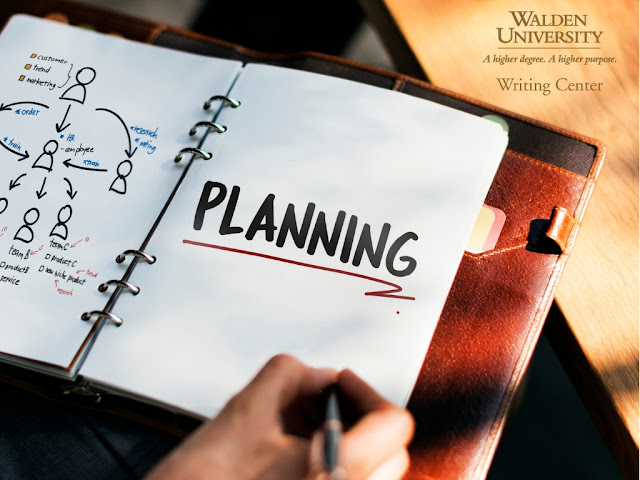
Did you know that writing is a process? For instance, when you read academic articles, the authors didn’t write their work in one sitting. Instead, they practiced prewriting, drafting, revising, and proofreading strategies to polish their work so that they could present their arguments clearly and effectively to readers. Of course, approaching writing as a process can also help writers with time management issues related to writing, such as writing under deadlines, and writing for a course while juggling work and other responsibilities.

Never miss a new post; Opt-out at any time

Want to learn more? The Writing Center has several sources
on all stages of the writing process. Don’t forget to share with us what prewriting, drafting,
revising, and or proofreading strategies you use that you find effective!
The Walden Writing Center provides writing resources
and support for all student writers including paper reviews, a podcast, live
chat, webinars, modules, and of course a blog.
Never miss a new post; Opt-out at any time
Thursday Thoughts: Global Days of Service 2018
Every year, Walden University celebrates Global Days of Service. Here in the Walden Writing Center, we participate by volunteering and sharing resources related to positive social change. This year, we have even initiated paper reviews for social change. As a scholar practitioner, you play a role in creating change in your field and society.

To honor this year's Global Days of Service, here are a collection of some of our favorite service-minded resources:
Social Change and Difficult Conversations: In this WriteCast episode, writing instructors talk about the importance in having a space in which to hold difficult conversations, as that is where social change takes place and is developed.
Using Restorative Writing to Enact Social Change: The Walden Writing Center hosts a series of webinars related to positive social change, and as you check out the archive be sure to pay attention to this newest webinar. New to restorative writing? We walk you through it and show how it can be a part of positive social change.
Creative Writing for Social Change: The Academic Skills Center also hosted a webinar looking at how writing can lead to social change. This recorded webinar looks at creative writing and the literary history of social change.
Student Spotlight Series: Here on the blog we like to highlight the wonderful work of our students, both in their coursework and in society. Start with this post about Jessica Meadows, a student in the College of Education, and then use the "Student Spotlight" tag in our blog to find more inspiring stories.
Social Change at the Writing Center: This page is a hub for the social change efforts of everyone here at the Walden Writing Center.
The Walden University Writing Center supports students throughout all stages of the writing process, including the development of texts that help to create positive social change.

To honor this year's Global Days of Service, here are a collection of some of our favorite service-minded resources:
Social Change and Difficult Conversations: In this WriteCast episode, writing instructors talk about the importance in having a space in which to hold difficult conversations, as that is where social change takes place and is developed.
Using Restorative Writing to Enact Social Change: The Walden Writing Center hosts a series of webinars related to positive social change, and as you check out the archive be sure to pay attention to this newest webinar. New to restorative writing? We walk you through it and show how it can be a part of positive social change.
Creative Writing for Social Change: The Academic Skills Center also hosted a webinar looking at how writing can lead to social change. This recorded webinar looks at creative writing and the literary history of social change.
Student Spotlight Series: Here on the blog we like to highlight the wonderful work of our students, both in their coursework and in society. Start with this post about Jessica Meadows, a student in the College of Education, and then use the "Student Spotlight" tag in our blog to find more inspiring stories.
Social Change at the Writing Center: This page is a hub for the social change efforts of everyone here at the Walden Writing Center.
The Walden University Writing Center supports students throughout all stages of the writing process, including the development of texts that help to create positive social change.
Never miss a new post; Opt-out at any time
Writecast Episodes 39 & 40: Positive Writing Affirmations
Hello, writers! In this month’s two-part podcast episode, we’re
presenting how to put a positive spin on your writing process with
affirmations. In Part I, Brittany and Beth discuss positive affirmations and how
they can impact your writing in a beneficial way. Brittany also makes a special
announcement in this episode, so turn up the volume. In Part II, listen to some affirmations and repeat them aloud to
practice mindfulness and positivity when getting into your writing head space.
As a preview, here are some of the positive writing affirmations that our hosts will introduce to you during these episodes:
Click on the player below to listen to each episode now! If you'd like to download the episodes, click the share button on the player, and then click the download button. To find a transcript of the episodes or our episode archive, head over to our WriteCast: A Casual Conversation for Serious Writers homepage. Happy Listening! As a preview, here are some of the positive writing affirmations that our hosts will introduce to you during these episodes:
- I am always learning.
- My goal is progress, not perfection.
- I will be kind to myself as I write.
- I am going to put away distractions and focus on my writing.
- My hard work today will pay off.
- And many others!!!
Start with Part 1 of the Positive Writing Affirmations episode:
And then listen to Part 2 of the episode to practice the affirmations:
.png)
Never miss a new post; Opt-out at any time
June Webinar Update
APA
,
Capstone Writing
,
Citations
,
Discussion Posts
,
Dissertation
,
Organization
,
Reading & Writing
,
Scholarly Writing
,
Writing Process
No comments
Happy June, Walden students! We hope your summer months are off to a sunny start! This month we have a range of webinars from APA to Capstone writing.

 The
Walden Writing Center provides information and assistance to students
with services like live chat, webinars, course visits, paper reviews,
podcasts, modules, and the writing center webpages. Through these
services they provide students assistance with APA, scholarly writing,
and help students gain skills and confidence to enhance their scholarly
work.
The
Walden Writing Center provides information and assistance to students
with services like live chat, webinars, course visits, paper reviews,
podcasts, modules, and the writing center webpages. Through these
services they provide students assistance with APA, scholarly writing,
and help students gain skills and confidence to enhance their scholarly
work.
Never miss a new post; Opt-out at any time

Every webinar presents
students with a live, interactive setting where you can ask questions of
writing center staff, work on practice exercises and questions, and develop a
better understanding of the topic being presented. This month, our topics include APA basics, paper development, the capstone writing transition, and critical thinking. Check out our schedule below. All times listed in EST.
You can click these links to register for the
webinar ahead of time! If you can’t attend live, don’t worry—you can check out our entire Webinar Recording Library here.
|
If you have any questions
about our webinar schedule or appointment scheduling system, e-mail us at writingsupport@waldenu.edu. We hope
to see you there!
Never miss a new post; Opt-out at any time
Writing Center Resource: Paper Reviews!
APA
,
Capstone Writing
,
Citations
,
Concise Writing
,
Grammar and Mechanics
,
Organization
,
Paragraphs
,
Reading & Writing
,
Revising
,
Scholarly Writing
,
Writing Center Services
,
Writing Process
No comments
Some of you may be familiar with the Writing Center’s paper
review service—maybe you use it often, perhaps you’ve heard of us
but never made an appointment, or maybe this resource is news to you! Regardless
of where you fall along this spectrum, we’re here today to remind you of what
paper reviews can do for you—even during a term break!

Paper reviews are asynchronous one-on-one reviews of your
coursework with a Writing Center writing instructor. Here are the steps to get started!:
- Sign up for an account in myPASS (my Paper Appointment Scheduling System).
- Make an appointment up to two weeks in advance with a writing instructor.
- Attach your paper in myPASS by 5 a.m. EST the day of the appointment (you’ll even receive a reminder email two days before).
Once you’ve attached your paper, sit back and relax! A writing instructor will read through your work and return it with helpful, supportive comments the day of your appointment or the day after your appointment. Your writing instructor will provide you advice on patterns in your writing, use specific examples from your work, and share resources to assist you as you hone your academic writing skills on everything from synthesis to citing.
How can you use this service during a term break? You are
more than welcome to submit work that you’ve already turned in! Make an
appointment for during the break, and let the writing instructor know in your
appointment form that you’ve already submitted the paper and are looking for help
on observing patterns in your work and learning some tools to assist you. You
can even revise that old paper to see if you’re understanding the feedback and are
able to implement it—then submit it for another review.
Term breaks are also great times to reserve two appointments
per week to get feedback on revisions you're making to longer-term writing
projects, like a doctoral premise or prospectus.
Making a paper review appointment during a term break is a
great way to hone your writing skills in a less time-sensitive environment than
during course time, while still continuing to advance your work and keep your
mind engaged in academic writing.
The
Walden Writing Center provides information and assistance to students
with services like live chat, webinars, course visits, paper reviews,
podcasts, modules, and Writing Center webpages. Through these
services they provide students assistance with APA, scholarly writing,
and help students gain skills and confidence to enhance their scholarly
work.
Never miss a new post; Opt-out at any time
May Webinar Update
APA
,
Avoiding Plagiarism
,
Citations
,
Grammar and Mechanics
,
Literature Review
,
Organization
,
Reading & Writing
,
Revising
,
Scholarly Writing
,
thesis
,
Writing Center Services
No comments
Happy nearly May, Walden students! We hope the flowers are blooming where you live! This month we have a range of webinars, including a brand new offering on plagiarism prevention.
The
Walden Writing Center provides information and assistance to students
with services like live chat, webinars, course visits, paper reviews,
podcasts, modules, and the writing center webpages. Through these
services they provide students assistance with APA, scholarly writing,
and help students gain skills and confidence to enhance their scholarly
work.
Never miss a new post; Opt-out at any time
Every webinar presents
students with a live, interactive setting where you can ask questions of
writing center staff, work on practice exercises and questions, and develop a
better understanding of the topic being presented. This month, our topics range
from literature reviews and reference lists to grammar and thesis statements. We also have a brand new webinar on Plagiarism Prevention that will help you avoid plagiarism in your work! Check out our schedule below. All times listed in EST.
You can click these links to register for the
webinar ahead of time! If you can’t attend live, don’t worry—you can check out our entire Webinar Recording Library here.
|
If you have any questions
about our webinar schedule or appointment scheduling system, e-mail us at writingsupport@waldenu.edu. We hope
to see you there!
Never miss a new post; Opt-out at any time
WriteCast Episode 37: Transitioning to Master's-Level Writing
APA
,
Learning Styles
,
News and Notes
,
podcast
,
Reading & Writing
,
Scholarly Writing
,
WriteCast
,
Writing Process
No comments
If you're starting or in the early stages of a master's degree program, then this is the episode for you! Join us for today's WriteCast podcast episode as Beth and Brittany break down differences between undergraduate-level and master's-level writing and share tips on how to transition between them in "Transitioning to Master's-Level Writing". Beth and Brittany discuss their own transitions between undergraduate and master's level coursework as well as ideas to assist Walden students with their transition.
Click the play button above to stream the episode. To download the episode to your computer, click the share button on the audio player, then click the download button.
Resources mentioned in the episode:
To access the full episode archive and transcripts, visit our WriteCast: A Casual Conversation for Serious Writers homepage. Happy Listening!
The WriteCast podcast is produced by Anne Shiell and the staff of the Walden University Writing Center and delves into a different writing issue in each episode. In line with the mission of the Writing Center, WriteCast provides multi-modal, on demand writing instruction that enhances students' writing skill and ease. We hope you enjoy this episode and comment in the box below.
Never miss a new post; Opt-out at any time
Click the play button above to stream the episode. To download the episode to your computer, click the share button on the audio player, then click the download button.
Resources mentioned in the episode:
To access the full episode archive and transcripts, visit our WriteCast: A Casual Conversation for Serious Writers homepage. Happy Listening!
The WriteCast podcast is produced by Anne Shiell and the staff of the Walden University Writing Center and delves into a different writing issue in each episode. In line with the mission of the Writing Center, WriteCast provides multi-modal, on demand writing instruction that enhances students' writing skill and ease. We hope you enjoy this episode and comment in the box below.
Never miss a new post; Opt-out at any time
Student Spotlight: Breanne Ahearn, Richard W. Riley College of Education and Leadership
The Walden University Writing Center is privileged to work with talented students. In the Student Spotlight Series, we aim to support incredible work our students do, both in and out of the classroom. The goal of the Student Spotlight Series is to provide the Walden community with a place to build bridges and make connections by developing shared understanding of the diverse and varied student journey. Students share stories about their writing process, their efforts towards social change, and their motivations for pursuing higher education. We ask questions, and students generously answer.This Student Spotlight features Breanne Ahearn, student of the Richard W. Riley College of Education and Leadership.
 |
| The WUWC Student Spotlight Series: Building Bridges. Making Connections. |
I’m originally from California, a small beach town just north of San Diego, to be exact. I spent a better part of my life enjoying things like the playing in the sand, spending time with friends, and bettering myself overall. As I’ve grown older, I have found those passions have only expanded. I’m a big fan of personal fitness. I love marital arts as a workout tool. I love to mediate, do yoga, spend time at the beach, hike mountain sides, and spend time with my friends and my best friend who is also my husband.
 |
| Best Friend and Spouse |
What is your educational background?
My educational background is bit diverse… I began college several years after many of my friends. I started as a pre-med major and, after having completed a number of classes in my concentration at the community college level, I realized I really wasn’t ready to take the next step and head off to a four-year university in Monterey Bay, California. So I stayed home and took a class in radio fundamentals (just for the heck of it). My first day, I was hooked. I was thrown (metaphorically) into the deep end of radio and found myself on the air my first day of class. Our campus radio station was like no other; we were Federal Communications Commission regulated and CNN News affiliated. In other words, there was no goofing around or child’s play allowed.
I started in the news division then worked my way up over the 4 semesters I was there to having my own show then becoming the station manager. I changed my major from Pre-Med to Communications and, after creating an award winning and nationally recognized radio documentary, I left California and finished my undergraduate degree in Atlanta, GA. While I was finishing my last two semesters of college, I was offered a job with a brand new radio news station with the second largest radio company in the U.S. While there, I took a leave of absence and moved to London, England, where I studied Television Journalism at Goldsmiths, University of London. After a year in the program, I had my Master of Arts degree and decided I wanted to continue my education into the doctoral field. Over the years, I have taught students, peers, colleagues, and I decided, instead of taking the journalism route as I have in the past, that I would study my doctorate under the education concentration and bend my journalism practices into teaching.
 |
| Breanne's must-haves for a successful day at work |
I grew up a student with a learning disability and, when you're told from a young age that you can’t do something or that the odds are not in your favor, you either accept defeated or you refuse to give up. In my career I am able to bend my practices in a direction that works best for me but, while at Walden, that hasn’t been the case. I have been forced to address issues that have long plagued my studies (statistics) and had to completely relearn how to write. I have used the support of my adviser, the Writing Center, and my professors with each new challenge. Not only has that support group been there to help me when I have a simple question or am completely off the mark, but the support I receive at home also contributes to my “I refuse to give up” attitude.
 |
| An example of the daily life of Breanne's career in broadcast journalism |
Since my time in community college I have found myself aiding others in their studies. There are areas I succeed at and there are areas that I require additional learning. However, I know, with the skills I have been taught, both at Walden and in my career, that I have the ability, knowledge, and experience to walk into a classroom or an office full of individuals who have that desire to learn more and to teach them. I don’t plan on leaving a newsroom just yet but I do plan on entering into a classroom and teaching the next generation while I continue to do what I love.
In what ways do you hope your dissertation/capstone will contribute to positive social change? Why is that important to you?
It is important for students in the communications concentration to understand the newest and most effective ways of learning in today's digital age. With that said, some four year universities continue to teach behind the times, and their students are suffering upon graduation. Many of them lack the experience to gain employment. Some are successful with getting a job only to find their education is in no way an aid in their chosen field and they must learn tools to be effective in today's field. In today’s world journalist are called amateurs, fake news writers, liars. A positive social change needs to take place, and it needs to start in the classroom. The only way for that to occur is if we, as educators, teach the most up to date and highly sought after practices.
Never miss a new post; Opt-out at any time
Revision Strategies: A Three-Part Blog Series
APA
,
Concise Writing
,
Organization
,
Paragraphs
,
Readers/Audience
,
Reading & Writing
,
Revising
,
Scholarly Writing
,
Writing Process
No comments
Today we’re here to talk about revision in
your writing. It’s important to build revision into your writing process for a
multitude of reasons, but you may not know how to get started. We bring you this revision blog series to assist you in incorporating revision into your writing
process.

Revision in your academic writing means taking some space
from your work and looking back at it critically. This is an important step
because it can allow you to see gaps in your ideas, where transitions can be
strengthened, and even catch typos. So how can you get started? Check out these
blog posts for assistance!
Revision By Subtraction: Writing Instructor Melissa writes
about tips and tricks to help condense your work and avoid unnecessary words
that can clutter up your meaning.
Be Your Own Best Reader: Editor Lydia writes about some ways
to incorporate revision into your process. Lydia goes over how to build time, space,
reflection, and a support system into your writing process to help you revise
to the fullest.
Developing Revision Strategies for Condensing Your Work: Writing
Instructor Claire discusses strategies to go back through your work after you’ve
finished a draft and some techniques to help you condense or cut out ideas you
may not need.
Use these blog posts to assist you in revising for
sentence-level issues, condensing ideas, and taking some space from your work
for reflection. With the assistance of these tools, you can incorporate
revision as a step in your writing process. Have some revision tips or found
one here that works for you? Share with us below!
The Walden Writing Center provides information and assistance to students with services like live chat, webinars, course visits, paper reviews, podcasts, modules, and the writing center webpages. Through these services they provide students assistance with APA, scholarly writing, and help students gain skills and confidence to enhance their scholarly work.
Never miss a new post; Opt-out at any time
Thursday Thoughts: Writing Refresh—Assignment Prompts as Outline
APA
,
Expert Advice
,
Flow
,
Organization
,
Paragraphs
,
Prewriting
,
Reading & Writing
,
Scholarly Writing
,
Writing Process
2 comments
Hello, Walden students! Today let’s talk a little bit about
the very first part of an assignment—the prompt. Did you know that you can use
the assignment prompt (often with a little bit of tweaking) as an outline for
your paper? Read on for some tips and resources to help you stay organized and
fully answer your prompts.

As you know, your assignment or assignment prompt lets you know what you need to write about in your paper, right? But with a little bit of tweaking and re-arranging, you can also use it to begin an outline for your paper and as a checklist at the end to ensure you’ve hit all the points.
The
Walden Writing Center provides information and assistance to students
with services like live chat, webinars, course visits, paper reviews,
podcasts, modules, and the writing center webpages. Through these
services they provide students assistance with APA, scholarly writing,
and help students gain skills and confidence to enhance their scholarly
work.
Never miss a new post; Opt-out at any time

As you know, your assignment or assignment prompt lets you know what you need to write about in your paper, right? But with a little bit of tweaking and re-arranging, you can also use it to begin an outline for your paper and as a checklist at the end to ensure you’ve hit all the points.
We have a wonderful webinar on interpreting your assignment that details various strategies and multiple examples of how to interpret and break
apart your assignment prompts. You can watch it, and dozens of other helpful live webinar recordings on our Webinar Archive page.
For discussion posts in particular, we have a great blog post that goes over the steps towards organizing a discussion post from the prompt itself here. You can also use these strategies to help you in larger prompts!
Here is a link to a podcast episode about “Doesn’t Meet Requirements” that goes over what this comment might mean and how to avoid it
by outlining and carefully looking over the prompt.
Essentially, all of these resources recommend that you take
a second look at your prompt and work to visually break it down. This might
involve highlighting, bolding certain words, or creating a mini-outline. Once
you’ve separated out the different elements of the prompt, you can be sure
you’re meeting the requirements! This might take a little practice, since
sometimes one sentence in a prompt might have a few aspects to cover in your
paper, but use these tools to assist you and soon you’ll be outlining from prompts
with ease.
Do you have any tips on using prompts to help you outline,
or find any of these resources particularly helpful? Share below!
The
Walden Writing Center provides information and assistance to students
with services like live chat, webinars, course visits, paper reviews,
podcasts, modules, and the writing center webpages. Through these
services they provide students assistance with APA, scholarly writing,
and help students gain skills and confidence to enhance their scholarly
work.
Never miss a new post; Opt-out at any time
Subscribe to:
Posts
(
Atom
)


