Bargain-Priced Candy Hearts and the Importance of Audience
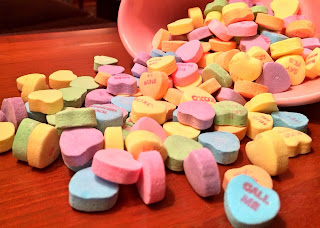
We've reached my favorite part of February: when all of the Valentine's Day candy goes on sale.

Digging through a
little box of colorful hearts, I can't help reading each little message as it comes up: "love", "laugh", "be mine",
"smile", "you & me", "cute", "rock
star", "hug me", and others are fairly obvious. But then there
are hearts with messages like: "TTYL", "DM me",
"lol" and "LYMY". I actually do understand the first three
(talk to you later, direct-message me, and laugh out loud) but the fourth is a
complete mystery to me. (EDIT: I've looked it up and apparently it stands for
"love you, miss you".)

This variety of mini-comments makes me think of what we mean when we advise writers to consider their audience. Maybe some of you already knew what LYMY meant. Maybe others would be confused by hearts reading "XOXO" or "BFF". Fortunately, the candy will taste the same whether you know that x's and o's are sometimes used to represent kisses and hugs in correspondence, or that BFF stands for "best friends forever," but scholarly writing does not benefit from the same sugary advantage.
Anything we write
has an intended audience--even if that intended audience is ourselves or an
intended audience of no one. When you write for coursework there is the obvious
audience of the faculty who will grade the work, but there is also often an
implied audience. Perhaps you've been instructed to write a lesson plan to
share with another educator; a business memo to be shared with a large
corporation; an interpretation of and diagnosis for a certain case study.
You'll of course want to make sure you respond to each component of the
assignment prompt, but you should also consider who you're conceptually writing
for.
-
What kind of information can you assume your audience will already
have about the topic?
o
Would you need to explain what TTYL stands for?
-
What context does your audience need?
o
The fact that they are Valentine’s candy would suggest that
messages like “smile” or “call me” have a different sentiment than they would coming
from a photographer or a business card.
-
What are you ultimately hoping to achieve with regards to your
audience?
o
When you send a Valentine to a friend, the message will likely be
different than the one you send to your romantic interest.

To help you remember how to acknowledge the importance of your intended audience, here’s a somewhat forced acronym relating back to candy hearts:
How: how are you expected to present your information? The mode of communication will provide some clues into who your intended audience might be.Expectation: what
can you expect your intended reader to already know?
Additional: what
extra background information will your reader need you to provide in order to
fully understand what you’re trying to say?
Response: is there
something you hope your reader will do with the information after reading? Are
there potential questions or arguments you could circumvent by addressing them
in your writing?
Task: what is the ultimate
task you’ve been given with regards to the assignment? Would your reader be
able to easily determine it based on what you’ve written?
To my intended
audience: I hope you had a fun Valentine’s Day—or are at least similarly
benefiting from reduced-price treats. And I hope this acronym and post in general
are memorable enough to help you in your next writing assignment!
 Kacy Walz is a writing instructor from St. Louis, MO. She is currently working on a PhD in Literature from the University of Missouri. Along with her work on the blog, Kacy also cohosts the Walden Writing Center podcast. She enjoys piña coladas and getting caught in the rain.
.png)
Thursday Thoughts: Remembering your Reader

- Our web page on audience gives an overview of the topic
- On the blog, Nik looks at how he learned to consider his audience and adjust his language and tone.
- We also have a WriteCast episode on audiences.
- How do you know your audience? Amber shares tips for reaching audiences on the blog.
- And if you are thinking of writing for publication, here is how to plan choosing your audience.

The Walden University Writing Center creates content to help students with a range of topics related to scholarly writing, APA style, and the writing process. We host webinars, and offer paper reviews, live chat, and a podcast.
Never miss a new post; Opt-out at any time
Thursday Thoughts: Top Ten APA Nuances

Never miss a new post; Opt-out at any time
Thursday Thoughts: Connection and Flow

Connection and flow across paragraphs and among points within paragraphs can help “glue” your overall argument together for readers, making it easier for readers to follow your argument.

Never miss a new post; Opt-out at any time


