Showing posts with label Social Change. Show all posts
October Live Webinars
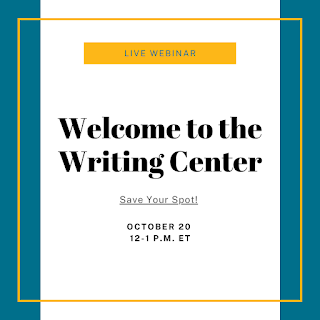
Next week, we're excited to host two live student webinars. "Welcome to the Writing Center" is a great webinar for you if you're new to Walden, haven't used the Writing Center much yet, or would like some guidance on what resources are most helpful depending on the time you have and your learning style.
October is a special month for the Walden community, as students, faculty, and staff come together with each other and in their communities to celebrate Global Days of Service. This year marks Walden's 15th Global Days of Service, a dedicated time to volunteer and enact positive social change through service.

To join in the celebration, our second webinar this month, "Using Restorative Writing to Enact Social Change," is a specialized discussion about using writing to transform pain into engagement and even potentially social change. In this interactive session, learn what restorative writing is, why it matters, and how to use it for healing, self-care, and building stronger communities.

If you can't attend the webinars live, visit our webinar recordings archive to access recordings and transcripts for all of our webinars. Better yet, register for the webinars below to receive the recording links by email as soon as they're available!
Welcome to the Writing Center
October 20, 12:00 p.m. – 1:00 p.m. ET
Register
This webinar will orient you to the many resources available at your fingertips, including paper reviews, extensive website and videos, Quick Answers, live and recorded webinars, self-paced modules, and social media. We'll specifically focus on which resources will be most helpful when you're short on time, have a few days to get help, or are looking to develop your writing skills long-term. Using Restorative Writing to Enact Social Change
October 22, 4:00 p.m. – 5:00 p.m. ET
Register

The Walden University Writing Center offers live webinars each month on academic writing topics such as scholarly writing, APA style, and practical writing skills.

Never miss a new post; Opt-out at any time
Thursday Thoughts: Writing For Social Change Webinar Series
One thing we take seriously here in the Walden University Writing Center is our students' commitment to positive social change. The programs of study they enter, the original research they produce, and their professional commitments all speak to the importance of Walden University's mission in their lives and work. These students use their skills, expertise, and determination to do amazing things for people all over the world.
Writing is central to this project. There are a variety forms and genres, not always scholarly, that can help these agents of change. So to support these scholar-practitioners in their journeys, our staff of professional writing instructors creates resources that are aimed specifically at supporting Walden students' social change goals. Below are three of our most popular social change resources: Live Webinar recordings of sessions that approach writing for social change in different ways.
Exploring Perspectives: In this webinar, you'll join a discussion about writing and social change. You'll have the change to discuss your own goals for social change and learn how writing can help you achieve those goals. Specific attention will be paid to how writing can help you generate ideas, as well as how you can use writing in areas like social media, grants, newspapers, and blogs to communicate your vision for social change.
Using Restorative Writing to Enact Social Change: Maintaining personal wellness is key to achieving your goals. Additionally, writing can be a useful tool for processing difficult events and discovering connections between your experiences and local, community, or global problems. In this webinar, you will explore how you can use restorative writing to promote wellness for yourself and your community. Information about the concept of restorative writing and how it evolved in academia will serve as the foundation for our discussion before you practice restorative writing during this webinar. Finally, you will reflect on how restorative writing can help you enact social change.
Grant Proposals: Sometimes achieving social change requires support from others. This webinar will give you tips for communicating your goals for social change through grant proposals, introducing you to this genre of writing. While we will not provide tips for finding grants, you will be able to use this webinar to help you communicate your social change vision to others in the grant format.

The Walden University Writing Center produces webinars that teach APA guidelines and writing skills for all Walden students, along with webinars specifically for undergraduate, graduate, and doctoral capstone students. Webinars offer live writing instruction, as well as an opportunity for students to connect via Q&A and chatting with staff and other Walden students, and each webinar is recorded for later viewing.
Never miss a new post; Opt-out at any time
Writing is central to this project. There are a variety forms and genres, not always scholarly, that can help these agents of change. So to support these scholar-practitioners in their journeys, our staff of professional writing instructors creates resources that are aimed specifically at supporting Walden students' social change goals. Below are three of our most popular social change resources: Live Webinar recordings of sessions that approach writing for social change in different ways.
Writing For Social Change Webinar Series
Exploring Perspectives: In this webinar, you'll join a discussion about writing and social change. You'll have the change to discuss your own goals for social change and learn how writing can help you achieve those goals. Specific attention will be paid to how writing can help you generate ideas, as well as how you can use writing in areas like social media, grants, newspapers, and blogs to communicate your vision for social change.
Using Restorative Writing to Enact Social Change: Maintaining personal wellness is key to achieving your goals. Additionally, writing can be a useful tool for processing difficult events and discovering connections between your experiences and local, community, or global problems. In this webinar, you will explore how you can use restorative writing to promote wellness for yourself and your community. Information about the concept of restorative writing and how it evolved in academia will serve as the foundation for our discussion before you practice restorative writing during this webinar. Finally, you will reflect on how restorative writing can help you enact social change.
Grant Proposals: Sometimes achieving social change requires support from others. This webinar will give you tips for communicating your goals for social change through grant proposals, introducing you to this genre of writing. While we will not provide tips for finding grants, you will be able to use this webinar to help you communicate your social change vision to others in the grant format.
The Walden University Writing Center produces webinars that teach APA guidelines and writing skills for all Walden students, along with webinars specifically for undergraduate, graduate, and doctoral capstone students. Webinars offer live writing instruction, as well as an opportunity for students to connect via Q&A and chatting with staff and other Walden students, and each webinar is recorded for later viewing.
Never miss a new post; Opt-out at any time
WriteCast Episode 56: Writing for Social Change: Letters to Legislators
In this episode of the WriteCast
podcast, Claire and Kacy sit down with Melissa Meghan, two Walden Writing
Center instructors, to talk about how they work toward positive social change
in their communities by writing to their local representatives. Claire and Kacy
ask Melissa Meghan to share how this type of writing is similar and different
to academic writing, the tools they use when writing for social change, and
their experiences with the process. As a student working to create positive
social change, we hope that this podcast episode helps you think about the ways
in which your academic writing can develop into other forms of writing.
To subscribe to WriteCast: A Casual Conversation for Serious Writers, click the icons in the player below or click "subscribe" for sharing options.
Visit our show page for a list of all of our WriteCast episodes and written transcripts for each episode.
Resources from this episode:
- Scholarly Voice
- Audience
- Using Evidence
- WriteCast episode #51: Using Evidence in Academic
Writing
- Writing for Social Change webinar series
- Walden Writing Center Blog posts on writing for
social change
- Social Change at the Writing Center
- Walden Writing Center weekly e-newsletter (e-mail writingsupport@waldenu.edu and ask
to be added to the distribution list)
The Walden University Writing Center supports Walden University in its goal of providing a diverse community of career professionals with the opportunity to transform themselves as scholar-practitioners so that they can effect positive social change.
Never miss a new post; Opt-out at any time
Virtual Conference Invitation: Water is Toxic and Food is Scarce. What Will We Do?
On behalf of Dr. Savitri Dixon-Saxon, Vice Provost, College of Social and Behavioral Sciences and Dr. William C. Schulz, III, Director, Walden Center for Social Change, you are hereby invited to an exciting event happening tomorrow, March 8th. Please join us for Walden University's free, virtual social change conference from 11 a.m. to 5 p.m. eastern time.

The conference, A Social Change Challenge: Water is Toxic and Food is Scarce. What Will We Do?, will engage in a robust exploration and dialog related to the direct and underlying causes that contribute to ongoing food and water insecurity and quality problems across the globe. This virtual, interdisciplinary conference will support Walden University scholar-practitioners in their collaboration for positive social change.
You can find the detailed conference agenda here.
Click here to reserve your spot for the conference.
If you'd like to learn more about Walden's Center for Social Change, please follow this link.
We hope to see you tomorrow, March 8th.

The Walden University Center for Social Change is a connective hub that promotes, facilitates, and supports collaborative partnerships, action research, and projects that lead to purposeful action for sustainable positive social change.
Never miss a new post; Opt-out at any time
Thursday Thoughts: Writing for Social Change
Life's most persistent and urgent question is, "What are you doing for others?"The Walden University Writing Center will be closed on Monday, January 21 in observance of Martin Luther King Jr. Day.
-Martin Luther King Jr.

In honor of Dr. King's dedication to social change, here are some of our favorite Walden Writing Center resources to help you write for your own social change projects, academic and otherwise:
- How to explain the social change implications of your work - an especially helpful blog post for Walden capstone writers
- A blog post in which we consider how social change can be created at the sentence level
The Walden Writing Center provides information and assistance to students with services like live chat, webinars, course visits, paper reviews, podcasts, modules, and the writing center webpages. Through these services they provide students assistance with APA, scholarly writing, and help students gain skills and confidence to enhance their scholarly work.
Never miss a new post; Opt-out at any time
Can Social Change Start At the Sentence Level?
As a Walden student, the main focus of your academic work is
likely creating positive social change. Your scholarly research may be on finding
therapies for treating PTSD or addressing a lack of housing assistance in your
community. These goals may seem distant while you pour over research and
critically analyze texts. However, as you are taking notes, developing your
thesis, and synthesizing your sources, change can occur on a smaller, local
level. One by one, the sentences you write can in fact be a source for good. By using active, rather than passive voice in your research writing, you can create
positive social change one simple sentence at a time.

When active
voice is used, the subject becomes the focus of the sentence. This emphasis
on the subject clarifies who is performing the action, and therefore, agency is
given to the subject. Using the active voice can create clarity and concision
in your writing, but it can also be a tool for giving your subject power.
For example, let’s take a look at a sentence in passive
voice: “The connections between BMI and heart disease were analyzed.” Here, the
attention is on what comes first in the sentence, “the connections,” rather
than who analyzed the connections. In passive voice, the researchers themselves
would not be important. Instead, what the researchers analyzed would be
emphasized.
Now, look closely at a similar sentence that has been
revised for active voice: “The researchers analyzed the connections between BMI
and heart disease.” Because the researchers come first, and they are performing
the action, the focus of the sentence is on the researchers and their work. The
reader’s attention is drawn to the researchers, rather than the connections
they analyzed.
While active voice can be used to clarify, it can also be
used to give a subject power and control. By using active voice in the
following sentence, I demonstrate patients’ agency over their own healthcare: “Every
day, the patients share their mental health concerns with their social worker.”
In this sentence, the patients are in control of their health, as they share their
concerns. The patients are not standing by while doctors and social workers
engage around them.
In the following example, passive voice takes away the
agency of the patient: “Every day, the patient’s mental health concerns are
shared with their social worker.” In this sentence, it is unclear who is
sharing the patient’s health concerns with the social worker. Perhaps a doctor
or staff member is providing this information on behalf of the patient, but the
patient is no longer in control. These may be small differences between
sentences, but with active voice, it is clearly communicated to the reader that
the patient has agency in the situation.
Let’s look at another example. In the following sentence,
passive voice emphasizes the object, trauma: “By using cognitive behavioral and
psychodynamic therapies, the trauma was worked through by the patient.
Alternatively, you could use the active voice to emphasize
the patient’s ability to overcome their trauma: “By using cognitive behavioral
and psychodynamic therapies, the patient worked through their trauma.” Here,
the power or control the patient has over their trauma is the focus. By using
active voice, the patient’s agency is celebrated, rather than trauma itself
becoming the focus.
While active voice creates clarity and concision in your
writing, more importantly, it is a way of holding the microphone for those who
have been silenced. It can be the means through which you share the stories of
others and give them control over their own experiences. Perhaps the steps towards social change really
do start at the sentence level. Through the structure of a simple sentence, you
can begin to write the steps for change.

Tasha Sookochoff is a writing instructor in the Walden University Writing Center. Along with earning degrees from the University of Wisconsin, Stout and Depaul University, Tasha has written documentation for the U.S. House of Representatives that increases government transparency, blogged for DePaul University, copy-edited the Journal of Second Language Writing, tutored immigrants and refugees at literacy centers, and taught academic writing to college students.
Never miss a new post; Opt-out at any time
Thursday Thoughts: Global Days of Service 2018
Every year, Walden University celebrates Global Days of Service. Here in the Walden Writing Center, we participate by volunteering and sharing resources related to positive social change. This year, we have even initiated paper reviews for social change. As a scholar practitioner, you play a role in creating change in your field and society.

To honor this year's Global Days of Service, here are a collection of some of our favorite service-minded resources:
Social Change and Difficult Conversations: In this WriteCast episode, writing instructors talk about the importance in having a space in which to hold difficult conversations, as that is where social change takes place and is developed.
Using Restorative Writing to Enact Social Change: The Walden Writing Center hosts a series of webinars related to positive social change, and as you check out the archive be sure to pay attention to this newest webinar. New to restorative writing? We walk you through it and show how it can be a part of positive social change.
Creative Writing for Social Change: The Academic Skills Center also hosted a webinar looking at how writing can lead to social change. This recorded webinar looks at creative writing and the literary history of social change.
Student Spotlight Series: Here on the blog we like to highlight the wonderful work of our students, both in their coursework and in society. Start with this post about Jessica Meadows, a student in the College of Education, and then use the "Student Spotlight" tag in our blog to find more inspiring stories.
Social Change at the Writing Center: This page is a hub for the social change efforts of everyone here at the Walden Writing Center.
The Walden University Writing Center supports students throughout all stages of the writing process, including the development of texts that help to create positive social change.
Never miss a new post; Opt-out at any time
Thursday Thoughts: Restorative Writing for Social Change
Social change is one focus that sets Walden University apart. Here in the Writing Center, we're excited to support writers as they work towards social change by offering several resources related to the topic.
 We are excited to add a new webinar to our webinar archive. Using Restorative Writing to Enact Social Change explores how you can use writing to work through difficult experiences and events and move towards social change in your community. In this hour long webinar that you can watch at any time, you will learn what restorative writing is and be able to practice it with several guided writing exercises.
Check out these other great resources related to restorative writing for social change:
The Walden University Writing Center helps student writers at all points of the writing process by providing one on one writing instruction, modules, webinars, a podcast, and blog.
Never miss a new post; Opt-out at any time

Check out these other great resources related to restorative writing for social change:
- WriteCast Episode 36: Social Change and Difficult Conversations is a podcast episode devoted to handling difficult conversations related to change
- In the blog post How to Write for Positive Social Change, Dissertation Editor Lydia talks through how to explain the social change implications of your academic work at Walden
- Exploring Perspectives is another webinar focused on writing for social change
- The Academic Skills Center has a Creative Writing for Social Change webinar in their archive and is also hosting a virtual conference on Using Your Skills for Social Change on October 4, 2018
- For more on the importance of social change here at Walden, see the Social Change at Walden web page

The Walden University Writing Center helps student writers at all points of the writing process by providing one on one writing instruction, modules, webinars, a podcast, and blog.
Never miss a new post; Opt-out at any time
Student Spotlight: Lisa Whiteaker, Richard W. Riley College of Education and Leadership
The Walden University Writing Center is privileged to work with talented students. In the Student Spotlight Series, we aim to support incredible work our students do, both in and out of the classroom. The goal of the Student Spotlight Series is to provide the Walden community with a place to build bridges and make connections by developing shared understanding of the diverse and varied student journey. Students share stories about their writing process, their efforts towards social change, and their motivations for pursuing higher education. We ask questions, and students generously answer.This Student Spotlight features Lisa Whiteaker, student of the The Richard W. Riley College of Education and Leadership.

How would you describe your personality to someone just meeting you?
People often initially describe me as being a sweet, kind person. Upon further inspection, I am also organized, meticulous, and goal-oriented. There are aspects of my personality that people are generally surprised about. I am quiet and sometimes shy, but I love fast cars, the color red, and Bon Jovi!
What are you passionate about? What are your hobbies?
As a teacher, I am passionate about education and making an
impact in the lives of children. I love learning more so I can apply my knowledge to help a child
learn. I am passionate about learning. I have always been a reader and hope I
can teach my students to love learning as well.
 |
| Here is Lisa in her backyard! |
What is your educational background?
My educational background is a combination of many experiences. I grew up in Wyoming, but moved to Kansas after graduation to be near my mom. In 1998, I completed one semester at Emporia State University. Then I attended a small Bible college for a few years in Missouri. After a long break from college, and after moving back to Wyoming with my husband and children, I went back to school at the age of 30 years old. I attended our local junior college, Casper College, to begin to finish up my degree. After Casper College, I transferred to the University of Wyoming at Casper. I really enjoyed every step of my journey and am thankful for all the teachers who made deposits in my life. My story shows that it is never too late to go back and pick up where you left off. It is never too late to make a decision to gain more education to better your life.
How do you fuel yourself during the writing process?
I am not sure if anyone else feels this way, but, for me, the
writing process is laborious. There is a definite cyclical process to writing, and I often feel as though I am slugging my way through it. I have found, though, the more time I invest in the process of collecting and organizing my
thoughts and systematically relaying my ideas in my rough draft, the less time
I have to invest in revising. To make it through the stages of writing, I
definitely need something to keep me going. To fuel myself during the writing process,
I turn to coffee, ice tea, and the occasional piece of dark chocolate. Also,
gathering more information through academic journals and my own personal
resource books fuels me. These sources help me to connect all the new
information I have acquired with my own personal experiences, tying the entire
writing process together.
What inspires you to write?
Currently, deadlines and due dates are my inspiration to write! Beyond what I must complete for the classes I am taking, I truly
believe that becoming a proficient writer is an important life skill. Being
able to communicate with others through words is a universal means of
connecting. This in and of itself is inspiring to me.
What is one Writing Center service you would recommend to new
students?
The Writing Center service I would recommend to new students is
having your paper reviewed. At first, it took me awhile to get my paper written
long enough in advance that I could have time to have my paper reviewed. Once I
got into the flow, it has not been difficult to get my papers finished in time
for a review. I would strongly recommend that new students use this valuable resource. I would also recommend choosing one specific person to review your
papers. It helps to have the same person looking over your writing because they
can give you specific feedback on how you are growing as a writer.
Have you encountered any challenges while at Walden and how did
you overcome those challenges?
Someone once told me, “The process is part of the promise.” Challenges
are a part of the process. I have taken this to mean that each valley and
mountain I encounter along my journey is part of what makes me who I am. Each
experience in my life gives me a skill or understanding that I can later share
with others. There have definitely been challenges while I have been pursuing
my master’s degree, and I have relied on my family, colleagues where I work,
and colleagues in my classes to help give me the strength to get me through to
the next phase. I have also relied on myself and I always remember that
sometimes the best things in life are those which are difficult to obtain.
What does social change mean to you? How have you worked toward
social change in your personal/professional life?
Part of what drew me to Walden University was the strong view on
positive social change, as this has always been important to me in my personal
life. To me, being an agent of positive social change means making a difference
in someone else’s life for the better. It means giving part of what I have or
know to make the way more equitable or easier for someone else. My husband and
I have always been people who have given to others. Though the ways in which we
have given may be small, they were significant to those who were the
recipients. My favorite quote is from The
Little Princess by Francis H. Burnett. In the story, Sara, the main character, has lost everything she held dear. It was at this point she declared, “If
nature has made you for a giver, your hands are born open, and so is your
heart; and though there may be times when your hands are empty, your heart is
always full, and you can give things out of that—warm things, kind things,
sweet things….”
This has always been my mantra and it guides me daily as I
interact with and come across people who need a friend and a helping hand.
Never miss a new post; Opt-out at any time
A Coda to GDS 2017: Writing Center Resources for Positive Social Change
At this point of Global Days of Service 2017, Writing Center staff have already contributed volunteer hours to help organizations like Habitat for Humanity, presented webinars on service and social change, and have helped students express the ways in which their scholarly and professional work will enact social change.
To continue this celebration of GDS 2017, we want to share some of the Writing Center's resources related to social change.

How to write for positive social change: This blog post helps students understand how to connect their work to social change.
Writing for social change webinars: We have an entire series of webinars related social change. These include topics like exploring differing perspectives to tips for communicating ideas in grant proposals.
Balance passion and objectivity: In this podcast, listen as we discuss ways to express our passion while remaining objective.
Social change and difficult situations: What do we do when we encounter different points of view related to social change? Writing Center instructors discuss this difficult situation in this episode of the podcast.
How do Walden students create social change: In our student spotlight series, you can read about the ways in which Walden students create positive social change. This link will take you to just one of the blog posts in the series. Feel free to search the "student spotlight" tag for more.
The Writing Center social change hub: Continue to explore the Writing Center's social change resources by starting on this webpage.
The Walden University Writing Center supports students throughout all stages of the writing process, including the development of texts that help to create positive social change.
Never miss a new post; Opt-out at any time
Inclusive Language Policy Announcement
Earlier in the year, members of the Writing Center formed a working group around social change initiatives, both those sponsored
by Walden University and those that we could spearhead on our own. One
of our earliest discussions in that group was one around gender-neutral and
gender-fluid pronouns, noting that while the
American Psychological Association (APA) indeed supported the use of the
singular they, APA did not raise awareness of pronouns being used by LGBTQ+ communities and subcommunities.

We looked to address this discrepancy in the following gender-neutral
pronouns policy, which we drafted over the summer and was approved by a number
of Walden’s committees and academic advisory boards, including Walden’s Research Process Advisory Council, the Diversity and Inclusion Working Group, and the Center for
Social Change. The policy states:
Gender-Neutral Pronouns Policy: Walden University prides itself as an inclusive institution that serves a diverse population of students. Committed to broadening the university’s understanding of inclusivity and diversity, Walden will now accept gender-neutral pronouns in student writing. This practice acknowledges APA’s recent endorsement of the singular they and also embraces alternative pronouns currently in circulation (e.g., the nominatives xe, ve, ze/zir, ey, and zhe and their associated derivations). Walden recognizes that discussion around gender identity is ongoing. As such, the university will accept any pronoun in student writing so long as evidence can be provided that it is accepted as a respectful term by the community it represents.
Coincidentally, while we were drafting this policy, another opportunity to revisit our language policies arose. Members of the autistic community reached out to us after we had tweeted about APA’s preference for person-first language. We provided an example in our webpage on bias that labeled the phrase “autistic child” as bias and “child with autism” as preferred. What our followers told us, however, was that, as members of the community, this was not their preferred phrasing. In fact, organizations like the Autistic Self Advocacy Network and Identity-First Autistic had been arguing for identity-first language, and Walden’s director of disability services reported that some in the Deaf community were also moving in that direction. Again, our social change working group was reminded of the importance of language inclusivity. We drafted the following identify-first language policy, which was also reviewed and approved by Walden’s aforementioned institutional bodies:
Identity-First Language Policy: Walden University respects the evolving endorsements of communities and self-advocacy groups. As such, while the American Psychological Association (2010) recommends using people-first language when addressing persons with disabilities (e.g., children with ADHD; p. 76), Walden also recognizes that certain groups or subgroups thereof prefer identity-first language (e.g., autistic children). To this end, the university will accept people-first and identity-first language in student writing so long as evidence can be provided that it is accepted as a respectful term by the community it represents.
Discussions about identity-language inclusivity will assuredly continue, and we're excited to serve on the Writing Center’s Social Change Working Group, which will be partially responsible for uncovering and discovering these conversations. We recognize that language is powerful, that a continued effort toward precision should include an awareness of social advocacy, and that we can support our community of learners with the tools they need to represent themselves and the communities they write about with respect.
With that in mind, we invite you, the Walden community, and
all of our readers to join us in this conversation below. An active and diverse
community helps broaden these discussions and raises cultural awareness around
identity. We welcome your thoughts and ideas.
Recently, we discussed these policies further in an episode of our our podcast for writers: WriteCast. Please click this link to access our entire WriteCast library, or click play on the player below. Thank you.
Recently, we discussed these policies further in an episode of our our podcast for writers: WriteCast. Please click this link to access our entire WriteCast library, or click play on the player below. Thank you.
The Walden University Writing Center reflects the social change mission of the university by supporting the research programs of its students. The Writing Center also reflects this mission by acknowledging that language itself has the power to contribute to positive social change by framing the way groups, individuals, and ideas are researched, written about, and discussed. Inclusive language can be the vehicle by which broader, longer-term social change is enacted.
Never miss a new post; Opt-out at any time
Global Days of Service: Community Partnerships and Social Change
Working with students, Writing
Center Administrative Assistants and those I “see” through the Writing Center,
provides me an opportunity to learn about the great work students do in the
name of social change as part of their studies, career paths, and volunteer
work. In fact, one aspect that drew me to Walden University as a Writing
Instructor was Walden’s
social change mission—social change is something that is both
professionally and personally important to me.

My own graduate studies were grounded in social change. As a
community literacy scholar, studying and presenting how everyday people go
public, social change meant helping to disseminate the voices of others—voices
not often heard across communities—to wide, disparate, audiences, such as
scholars, activists, and others who might find inspiration from these voices to
enact their own social change mission. However, writing about communities and
people when one is positioned as an outsider to that community is, well,
complicated. Thus, as we kick off the Global Days of Service here at Walden
University, I’m reminded that it’s important for those who enter a community
with the goal of social change to do so ethically by understanding one’s own
outsider status and keeping the community’s true needs in mind.
Luckily, as a discipline, community literacy provided me a
foundation for facing this complicated situation of studying, writing about,
and volunteering for communities I was an outsider to. For instance, I observed
and interviewed community members of a group who were going public against the
racial discrimination and sanctions they faced in relation to their immigration
status. As someone whose race, immigration status, and subsequently, social and
political experiences differed from this group, I was a community “outsider” in
relation to their status as community “insiders.” That said, community literacy
practices are grounded in changing the dynamics of this outsider-insider
issue—not by pretending to close this gap, but by acknowledging it and
respecting the various insider-outsider dynamics and differences at work. I
quickly learned that these dynamics and differences are fluid, much like an
individual’s intersecting identities (gender, race, class, etc.) are fluid.
So, while I was observing and interviewing community
members, it was important that I considered my own
outsider status to include how the group I was writing about was not static
in terms of identity or social and political public position. One way to
achieve this was to ensure that the group I studied co-created my research—their
voices were always at the forefront of my work and they provided feedback on my
notes and writing along the way. Thus, my work was not the result of passive,
unreflective observation and interviewing group members, but the result of
self-reflection and ethically fostered relationships and communications.
Equally important to ensuring that the voice of the
community led my work was ensuring that I volunteered for the community for
allowing me to study them and did so on their terms. More specifically, in
exchange for allowing me to study the group, I provided some much-needed
volunteer work—work that helped the group continue to meet and grow. In this
case: babysitting.
Admittedly, babysitting was a less glamorous reality of
volunteering and social change work than I expected. In my mind, I imagined
myself more at the forefront—helping with organizing marches or discussing
tactics for going public—after all, I had a background in public rhetoric. I might
have requested to do something more “glamorous” as opposed to holding one end
of a jump rope up or playing tag. However, I was an outsider to this community
and this was not my social and political cause. That said, working with this
group allowed me to reflect on my own understanding of what volunteer work
means and how it should be driven by the needs of the community one is
volunteering for.
If there is an overall “moral” to my volunteer work, it was
that, no matter what your area of expertise is or what you think you should do
to best support a community, volunteer work should be about what is most needed
for that community at the time according to the community being volunteered
for. Even the seemingly smallest tasks, such as babysitting, can have a huge,
positive impact on a community. For instance, without babysitters, many
community members would not have been able to meet with the group at all. Even
the smallest task requested can prove to have an important outcome for a
community.
When I volunteer during this year’s Global
Days of Service, I will keep in mind
that acknowledging and respecting the voices, positions, and intersecting
identities of others also means ensuring that the volunteer work I do is on the
terms of the community I volunteer for. After all, social change is grounded in
the need for people and communities to work together.

Veronica Oliver is a Writing Instructor in the Walden Writing Center. In her spare time she writes fiction, binge watches Netflix, and occasionally makes it to a 6am Bikram Yoga class.
Never miss a new post; Opt-out at any time
GDS 2017: Part of Something Larger
Social change is at the center of Walden University’s mission and vision statements for each college. Walden students are
often asked to reflect on how their academic work and future professional work
can enact positive social change. This week, we want to celebrate the
importance of social change here at Walden University.

The timing is perfect as well. Global Days of Service is kicking off this week. The Writing Center is always
excited to get to take part in GDS and help support the vision for greater
social change.
Explore Walden University’s commitment to social change:
- What does social change mean to Walden University?
- Meet some social change agents
Next week we’ll continue our celebration of GDS on this blog with posts that examine the idea of positive social change through action and language. As you learn more about social change at Walden, and how the Writing Center supports that commitment, we hope you'll join us.
Walden University and the Writing Center provide a diverse community of career professionals with the opportunity to transform themselves as scholar-practitioners so that they can affect positive social change.
Never miss a new post; Opt-out at any time
Subscribe to:
Posts
(
Atom
)


