Embracing the Learning Process: Transitioning from APA 6 to APA 7
It’s been 10 years since I first began my journey to master
APA. When I began working in the Writing Center in 2010, APA had just published
its sixth edition of the manual, so it was a perfect time for a new writing
instructor like myself to dive in headfirst. Those early months of learning APA
were frustrating. I can’t tell you how many times I looked up the rules for
when to use “et al.” or when exactly an issue number was needed in a reference
entry. Slowly but surely, however, I mastered APA’s rules. As I practiced
using the style, both in my own writing and by teaching
it to students, APA’s rules became second nature to me.
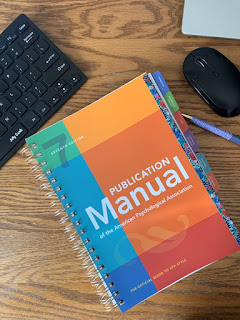
On the positive side, these feelings of frustration have also been productive. As
I labor over the new edition, practicing the new way to reference a webpage or
including “et al.” in all citations with three or more authors, I’m reminded
that my feelings of frustration are simply part of the learning process.
Learning often isn’t comfortable; it’s challenging, and it requires us to step
outside of our comfort zone to learn to think in a new way. And so, with this
learning process, I also am reminded of the student experience. It’s been quite
a long time since I went through the process of first learning APA, and so
learning APA 7 has given me insight into the challenges and frustrations of any
Walden student who is new to APA style.
- Acknowledge the Challenge: Learning APA 7, like any learning, is a process; there will be frustrations and challenges along the way. Acknowledging—and if possible, embracing—this challenge will help you avoid feelings of failure if you make a mistake or frustration if it’s taking some time.
- Give Yourself Time: I’ve had 10 years to absorb APA, and it’s unrealistic to expect that I'll memorize and use APA 7 intuitively in a short period of time. Similarly, using APA 7 will add to your writing time, since you’ll most likely need to look up rules and double-check formats.
- Use Resources: Once you begin learning and using APA 7, don’t feel like you’re in this alone. The Writing Center is working on a number of resources to help you transition into using the seventh edition. We will have fully updated APA resources throughout our website, so you can use tutorials on our website and services from our writing instructors and form and style editors to support your learning of APA 7. In the mean time, you can visit our APA 7 Transition page for the latest updates and a comparison table so you can see the biggest differences in the APA editions.
- Ask Questions: Don’t forget to ask questions, too: You can email us or visit our Live Chat Hours with questions about APA 7 after the May switch dates. Your faculty and classmates can be a great source of support, too. I can’t tell you how many times I've reached out to colleagues to confirm I’m using a new APA 7 rule correctly.

We look forward to working with you as you engage in your own learning process with APA 7, and we’re pleased to support you on this journey. And hey, if you find yourself loving a new rule or experiencing a particular challenge, be sure to let us know. We’re all in this learning process together!
 Beth Nastachowski has
been with the Writing Center since 2010, and she currently manages the center’s
webinars, modules, and videos. She spends her time running after her son,
husband, two cats, and dog in St. Paul, MN.
Beth Nastachowski has
been with the Writing Center since 2010, and she currently manages the center’s
webinars, modules, and videos. She spends her time running after her son,
husband, two cats, and dog in St. Paul, MN. .png "Send me new posts by e-mail!")
Never miss a new post; Opt-out at any time
Interview with Patrese Nesbitt, Walden DrPH student and 2019/2020 Writing Center Intern
In 2019, Patrese began a 9-month internship with the
Writing Center, during which she learned about writing center pedagogy, giving
writing feedback to students through our paper review appointments, and attending the International Writing
Centers Association conference in Columbus, OH. We are grateful Patrese was
interested in the internship, as she is also working full time as a faculty
member and pursuing her Doctor of Public Health from Walden. She is also now a
published author on the Writing Center blog with her blog posts “The Art of Storytelling: Mastering Paraphrasing” and “How to Manage Procrastination and Brain Fog,”
where Patrese brings her unique perspective as student, faculty member, and
writing center intern to give students writing advice.

Join us in learning a bit about Patrese, how she manages so many responsibilities in her life, and her tips for other Walden student writers.
Writing Center: What are you studying at Walden?
Patrese: Doctor of Public Health (DrPH)
Writing Center: You are also a faculty member at your institution. What do you teach?
Patrese: I am an Assistant Professor and I teach Health and Physical Education at Kentucky State University in Frankfort, Kentucky.
Writing Center: How do you spend your free time?
Patrese: I spend my free time reading, working out, traveling with family and friends, watching make-up and hair tutorials, or studying about mindfulness and health.
Writing Center: You have a lot going on: How do you keep track of everything or keep yourself organized? How do you make time for it all?
Patrese: I have and stick to a “to-do” list! I have a “to-do” list at home which is a dry erase board, updated daily. My “to-do” list is just a notebook at work. As you can imagine, I’ve gone through a lot of notebooks!

Writing Center: What is your approach or goal to one-on-one paper reviews and when giving students writing feedback?
Patrese: I want to make sure the student knows that I am aware of their own personal goals of their paper review appointment. I do so by stating their goals at the start of their paper review appointment. I may also state their personal goals throughout the paper; sometimes I may ask “what do you think?” to the student to show that I am engaged but I am open to their interpretation and suggestions as well. It is a learning experience for the both of us!
Writing Center: Why or in what ways do you think students can benefit from a one-on-one paper review appointment?
Patrese: One-on-one paper reviews are an exceptional way to have an individualized review based on your goals, tasks, and abilities. I’ve benefited from a one-on-one appointment at the very beginning of the DrPH program, and it was superior! While I had the opportunity to attend writing centers at my prior institutions, one-on-one paper reviews, in an asynchronous format, feels as if the writing instructor has time to review my personal information without making me feel embarrassed!Writing Center: What have you benefited the most from or learned the most about during your Internship with the Writing Center?
Patrese: I increased my knowledge base on the number of tools the Writing Center has towards improving writing. The increased knowledge provided from the internship will help with the success of my dissertation.
Writing Center: What’s one thing you’ll take away from the Internship and use in your writing at Walden or your teaching at your institution?
Patrese: Appointments! More students should take advantage of making appointments with the Writing Center to achieve their goals as well as staying on task in their course. I will actually make more appointments! So, Beth, Amy, and Max will certainly see more of me!
Writing Center: What is the most helpful advice you’ve received about writing?
Patrese: I find myself typing how I talk, which is ok, but I firmly believe in the process of proofreading/self-editing. You learn so much about your writing style and it helps to ensure you are on task. One more note: follow the MEAL Plan for your writing as if your life depended on it!
Writing Center: Could you talk about a particular writing challenge you faced and how you overcame that challenge?
Patrese: I procrastinate! I prepared a blog about procrastination and it is something I still struggle with as a doctoral student. As one who has struggled with anxiety, I’ve used procrastination to cope with anxiety due to fearing (or overthinking) that what I am writing about is wrong, or I am off topic, and the worst can happen as a result of poor writing. Having a “to-do” is list extremely helpful and has helped me to overcome that challenge. I can always tell when I operate “away” from my “to-do” list. I am not as focused, and distractions are everywhere.

Writing Center: What’s one writing accessory you can’t live without—or something you couldn’t write without?
Patrese: A college ruled, $0.69 notebook! I carry at least one everywhere!! Especially now as I am getting closer to writing my dissertation!
Writing Center: Describe your approach to writing in three words:
Patrese: Prepare, plan, pray.
Prepare: Get all the tools that are needed; read the material that helps to reference what you are writing, use a notepad to mind-map or outline what your paper will state, and find a comfy sitting area to write your paper.
Plan: Back to the “to-do” list! Break apart difficult tasks or break apart tasks that may be big (or time consuming) and may lead to overthinking and anxiety.
Pray: or be mindful in what you are getting ready to do. Mindfulness to me means being “in the moment”. Praying helps me to get in the moment and put all my focus on the task from start, through the process, and to completion.

Never miss a new post; Opt-out at any time
An APA 7 Update and Resources
We here in the Walden University Writing Center recently updated our APA 7 transition webpage to provide more information about how we’re preparing to
help Walden University students use the APA’s new style guide.

To help support Walden students’ transition, the instructors
and editors of the Writing Center are working to learn the details of the new
style guide, update our instructional resources, and create new resources. For
example, these APA 6 and 7 comparison tables provide a concise preview of the significant
changes between the old and new version of the manual. These tables are just
one example of the type of resource our staff is working on to highlight and
help you learn the changes.
We also just published a WriteCast podcast episode
on a few of the APA 7 changes that we’re most excited about. Stream or download (click the connect button on the player) the episode
here, or listen on your favorite podcast app. If you have heard or read about
upcoming changes, we’d love to know which ones you are looking forward to the
most!
Please bookmark our APA 7 transition webpage to learn about when new Writing Center resources will go
live and for information about the official Walden University timelines for the
transition. We’ll continue to share updates with you on resources, training,
and timelines as we all make this exciting move together!
Any questions related to the transition to APA 7 can be directed to APA7@mail.waldenu.edu.
Any questions related to the transition to APA 7 can be directed to APA7@mail.waldenu.edu.
Never miss a new post; Opt-out at any time
How to Manage Procrastination and Brain Fog
 |
| Image used with permission from Pixabay |
Anxiety presents another layer to brain fog,
which can lead to procrastination. The Social Anxiety Institute stated that anxiety
increases as we place too many tasks on ourselves at once. This can lead to
procrastination because of the excessive number of tasks to complete.
Additionally, Dr. Harriet Learner in Psychology Today
also stated that anxiety causes brain fog. Frequently we assume doing something
unrelated to writing a course paper can help us towards getting the course
paper completed. With that said, we might reflect on whether procrastination on
social media is just adding to or maintaining our list of tasks to complete,
perpetuating anxiety.
Short term anxiety can create short term brain
fog, and long term, or chronic, anxiety can be a powerful force—but thankfully,
not a permanent force. When it comes to writing a course paper, it is easy to
think too far into the future (being afraid of a negative outcome of the course
paper), and not be mindful of the moment, or utilize tools that help us to
break down the task.
In my work towards my doctorate degree,
I’ve gone down the social media dark hole as well as dealt with significant
personal and professional challenges, sending my anxiety overboard and placing
me in what feels like a huge brain fog. By working to overcome procrastination
and brain fog has helped me move closer towards finishing. Below, I’ve
included a few tips to help you with procrastination and brain fog:
1. Therapy: Therapy has been the most excellent tool in my academic success at Walden University. Therapy helps me talk through life’s obstacles that may place me into brain fog. As mentioned earlier, anxiety can lead to brain fog, but so can depression, grief, sadness, or trauma. Therapists work closely with their clients to help resolve these issues. Resolution can lead to success once the client is open to seeking opportunities that will help them thrive, both personally and academically.
2. Breaks from social media: Technology like smartphones and computers allow us to be constantly "plugged in" to the news and current events. Being plugged into social media too much feeds procrastination and could lead to anxiety. One way to address this is to make social media applications less easy to access. You might consider removing these apps from your phone or using website blockers or timers to limit your access.
3. To-do list or planners: I am willing to give the office supply store my income based on planners alone. Not only do I love them, but planners and to-do lists keep me on track and organized. I use them to ensure I am not missing out on anything important, such as assignments, webinars, meetings, and coursework related tasks. Staying organized keeps me on track and helps me to avoid procrastination.
4. Meditation and Mindfulness: As a yoga instructor, I know that the purpose of meditation and mindfulness is to consider the thoughts that make us feel upset, sad, or anxious and to focus on the thoughts that make us feel empowered, happy, refreshed, energetic, and accomplished. It’s the practice of knowing and focusing on the “now” and not “back then” and “in the future.” Using meditation and mindfulness when dealing with brain fog, as the writer, helps to focus on what you are doing, in that very moment. Meditation and mindfulness help the student to focus on their ability to produce the very best course paper by encouraging focus on that exact task and nothing else. By focusing on being in that very moment of creating a paper, you can navigate out of your brain fog!
1. Therapy: Therapy has been the most excellent tool in my academic success at Walden University. Therapy helps me talk through life’s obstacles that may place me into brain fog. As mentioned earlier, anxiety can lead to brain fog, but so can depression, grief, sadness, or trauma. Therapists work closely with their clients to help resolve these issues. Resolution can lead to success once the client is open to seeking opportunities that will help them thrive, both personally and academically.
2. Breaks from social media: Technology like smartphones and computers allow us to be constantly "plugged in" to the news and current events. Being plugged into social media too much feeds procrastination and could lead to anxiety. One way to address this is to make social media applications less easy to access. You might consider removing these apps from your phone or using website blockers or timers to limit your access.
3. To-do list or planners: I am willing to give the office supply store my income based on planners alone. Not only do I love them, but planners and to-do lists keep me on track and organized. I use them to ensure I am not missing out on anything important, such as assignments, webinars, meetings, and coursework related tasks. Staying organized keeps me on track and helps me to avoid procrastination.
4. Meditation and Mindfulness: As a yoga instructor, I know that the purpose of meditation and mindfulness is to consider the thoughts that make us feel upset, sad, or anxious and to focus on the thoughts that make us feel empowered, happy, refreshed, energetic, and accomplished. It’s the practice of knowing and focusing on the “now” and not “back then” and “in the future.” Using meditation and mindfulness when dealing with brain fog, as the writer, helps to focus on what you are doing, in that very moment. Meditation and mindfulness help the student to focus on their ability to produce the very best course paper by encouraging focus on that exact task and nothing else. By focusing on being in that very moment of creating a paper, you can navigate out of your brain fog!
Never miss a new post; Opt-out at any time
The Art of Storytelling: Mastering Paraphrasing
As an avid reader, I love stories about revolutionaries, abolitionists, orators, or great public speakers. I am particularly drawn to stories pulled from African American history: Harriet Tubman, Malcolm X, Madam C.J. Walker, and my favorite, Shirley Chisholm, the first African American female to run for President of the United States.
You might have thought I read an entire book about the life of Ms. Chisholm, based on my mentioning she was the first African American female to run for the presidency. I actually did not read a book about Ms. Chisholm. Instead, I pulled various online resources about the life of the former Congresswoman from the Smithsonian and the U.S. House of Representatives websites, as well as scholarly articles about her life and history as an educator.
So, is this how paraphrasing works? You pull pieces of information from different resources and articles and put them in a paper? Well, sort of. As you continue reading, you will find this post is intended to help you get comfortable with paraphrasing by providing some encouraging insight on how to tell a story. Crafting your story from your interpretation of course assignment readings and research articles may appear to be a daunting task. Still, your professor will be impressed by your efforts in understanding the content from the course, which ultimately aids in your application of the gained knowledge to your profession and your passion.
My story is similar to Ms. Chisholm’s—I am somewhat of a revolutionary, or as my mom would call me, headstrong. I have New York and Caribbean roots (Dad was Jamaican American), and I love my current full-time career as an assistant professor. Ms. Chisholm’s facts are easy to paraphrase for me because I so easily relate her life to my own story and experiences. We both possess one key element, which is that we both hold a commitment to social change.
So, when you paraphrase, think of how you can relate the information to your own story. Here are some tips that may be helpful:
1. Determine your interest: When reviewing your course assignments, find information that is of importance to you. The assignment is much easier to interpret when you have interest, even if it is just a small part of a chapter from a course assignment.
2. Consider social change: I get it, there may not be any articles directly applicable to you or your background. Therefore, find content that encourages and inspires you to be a change agent. Ask yourself, what could you or what would you do differently from this article that would contribute to social change in your career field?
3. Use those bright highlighters: Highlight and note parts of articles and chapters that stand out to you the most. Often times, those points will help you to understand the material from the article better. Highlighting also shows your professor that you know the text, which further helps you to understand the assignment with proper execution.
4. Have no fear, my friend: Do not be fearful of words that you don’t know the definition of. Highlight those words and use the thesaurus tool in Microsoft or look up the meaning of the highlighted word. No harm in looking up the meaning of individual words to get your point across in a scholarly manner without copying something directly from the article.
5. And Again, re-read! There may be areas you may have missed or additional areas you want to highlight.
Plagiarism, Citations, and Quotations: In your reading, you may find out that an author’s description of a topic is clear, concise, and well written; therefore, it may be easy and effortless to just directly copy the content into your course assignment. Before you do, ask yourself, “did I give the author credit for their work?”, “did I quote or paraphrase?”, and “is this something I would say in getting my point across about the content?”
1. Professional Advice: Review your work. Ask yourself, “Is this what I want to say about this article?” “How did this article resonate with me?” “Did I cite facts?” “Did I properly give my interpretation of this article?” and the most critical question, “Did I answer my professor’s question?”
2. Be confident: Most importantly, be confident! You are the author, so your text, your interpretation, or your story is vital for the learning experiences, not only for yourself but for everyone else who reads your writing.
As you are crafting your own interpretation of something you read or are paraphrasing, picture it as the most exciting topic one has ever wanted to read. Spare no details and confidently present to the reader, as an author, your interpretation of what you read. Think about who you might be helping as a result of your storytelling.

Patrese Nesbitt is a writing intern at the Walden University Writing Center. She enjoys reading articles that are inspirational, in addition to doing research on how certain physical movement patterns help with mental health. As a doctoral candidate in Walden University’s Public Health Program, she is eager to find ways to intrinsically and extrinsically motivate people to live an improved and upgraded quality of life.
Never miss a new post; Opt-out at any time
Subscribe to:
Posts
(
Atom
)


