Webinar Update: February Webinars!
Happy February, Walden students! We hope your first month of
2017 was full of fresh starts and continued progress. This month we’re here to
keep up that new year momentum with some wonderful webinars.

The Walden Writing Center provides information and assistance to students with services like live chat, webinars, course visits, paper reviews, podcasts, modules, and the writing center webpages. Through these services they provide students assistance with APA, scholarly writing, and help students gain skills and confidence to enhance their scholarly work.
.png)
Never miss a new post; Opt-out at any time

Every webinar presents
students with a live, interactive setting where you can ask questions of
writing center staff, work on practice exercises and questions, and develop a
better understanding of the topic being presented. This month, our topics range
from interpreting assignment prompts to literature reviews to nontraditional
sources.
You can click these links to register for the
webinar ahead of time! If you can’t attend live, don’t worry—you can check out our entire Webinar Recording Library here.
|
If you have any questions
about our webinar schedule or appointment scheduling system, e-mail us at writingsupport@waldenu.edu. We hope
to see you there!
The Walden Writing Center provides information and assistance to students with services like live chat, webinars, course visits, paper reviews, podcasts, modules, and the writing center webpages. Through these services they provide students assistance with APA, scholarly writing, and help students gain skills and confidence to enhance their scholarly work.
Never miss a new post; Opt-out at any time
Too Few? Too Many? A Dissertation Editor's Tips for Effective Citation Frequency
Effective citation is a pivotal element of scholarly writing
and is something that demands ongoing skill building. Properly attributing
information sources is important for avoiding academic integrity issues. But,
equally as important, it helps you demonstrate your knowledge of the literature
in your field as well your chosen citation style (APA, at Walden) to readers.

Many Walden University doctoral students have a good understanding of key
APA citation and reference guidelines by the time they reach the capstone
writing stage. However, when editing students’ work for form and style, I often
notice that students either do not include citations when they should or they
include them when they should not. In my post today, I want to further discuss
both scenarios.
Too Few?
Let me focus first on the absence of necessary citations in
capstone documents. I most often see this issue in the problem statement
section. In providing a rationale for one’s study, a student asserts that inadequate research has been done in a certain area and that a gap exists in the literature (hence, the need for additional research in the form of the
current study).
To persuasively make such a statement, however, one needs to
cite relevant studies that have been conducted as well as summarize key
findings and knowledge arising from this research. Doing so demonstrates that a
student has conducted a thorough literature review and is well-versed in the
literature in your field. It also reinforces to a student’s committee members
and other readers that she or he has carefully thought out the relevance of the
research being undertaken.
But, sometimes, when students state their research problems,
they do not include adequate or any substantive evidence to substantiate their
informational claims. This is one instance where effective citation can
definitely help. While each student’s capstone is unique, I typically recommend
using the following format, either in multiple paragraphs or a single one, to
show your reader that your claims are indeed supported by the literature. The
capstone writer should do the following:
Step 1: Note areas that have been studied – for instance, with a statement such as “researchers have conducted studies of x (see Author A, 2016; Author B, 2015; Author C, 2012)."
Step 2: Summarize key research findings – for instance, with a statement such as “they have found evidence of y (Author A, 2016; Author B, 2015; Author C, 2012)."
Step 3: Point out significant gaps in knowledge – for instance, with a statement such as “based on my review of the literature, researchers have not adequately studied z.”
Step 4: Then, provide more elaboration about why further research is needed.
This is one example of how the inclusion of citations in
one’s writing helps to elicit reader buy-in and establish credibility in the
writer.
Too Many?
On the other hand, in editing capstone studies, I have also observed
instances in which citations have been unnecessarily or inappropriately
included, in my opinion. I most often observe this issue in the methods section
of capstone studies, especially when students are describing their research
protocols.
Considering the following statement: “I used inductive coding
to analyze data for emergent themes (Creswell, 2013).” In this sentence, no
citation is needed because no information is being presented from Creswell. The
writer is merely reporting on her or his data analysis procedures. If you’d
like to learn more about this trap and how to avoid it, check out this clever
blog post, Creswell Did Not Write About You, written by my fellow Writing
Center dissertation editor, Tim.
Including citations when they are unnecessary can confuse
readers and potentially diminish a writer’s credibility, as the Creswell scenario
shows. Reading this sentence, I am unclear why Creswell is being cited. As the reader, I reason that the student is trying to indicate that she or he followed Creswell’s protocol, but I am uncertain. And, the uncertainty makes me a bit less confident about the writer’s knowledge. To clarify things, I would recommend that a student either delete this citation or include “see” before the citation (to indicate that Creswell is being used as an example).
Mastering these citation skills can, indeed, be challenging. But effective citation practice is not something that writers are born with. It takes practice. So with sustained effort, learning these skills is definitely doable, in my view.
To help you along the way, Walden University Writing Center
offers several asynchronous and synchronous resources focused on APA citation,
references, and manuscript style. Our modules and webinars are good places to start.

Tara Kachgal is a dissertation editor in the Walden University Writing Center. She has a Ph.D. in mass communication from the University of North Carolina at Chapel Hill, and teaches for the School of Government's online MPA@UNC program. She resides in Chapel Hill and, in her spare time, serves as a mentor for her local running store's training program.
Never miss a new post; Opt-out at any time
Thursday Thoughts: New in the Writing Center--Knowledge Checks

Do you ever receive feedback or visit pages on the Writing Center’s website and think—wait, do I know about that? Sometimes language in an writing instructor or editor's comments or that you read over might sound familiar, so you assume you remember—but maybe it’s been a while or maybe you’d just like to test yourself to be sure. Now you can with our handy knowledge checks!
What exactly is a knowledge check? It’s a quick little quiz that you can easily take in a sidebar on one of the webpages (listed below). You answer the questions and then can scroll through to see which answers are correct. For the ones you got incorrect—you can go through the webpages on your own to dig into the rules that apply, read some examples, and try taking the quiz again if you like (you’ll need to refresh the page to do so).
To find the knowledge checks, simply go to one of the webpages below and look on the right side of the screen for the brown tab reading “Knowledge Check” to test your knowledge!
Here's what the knowledge checks tab looks like:
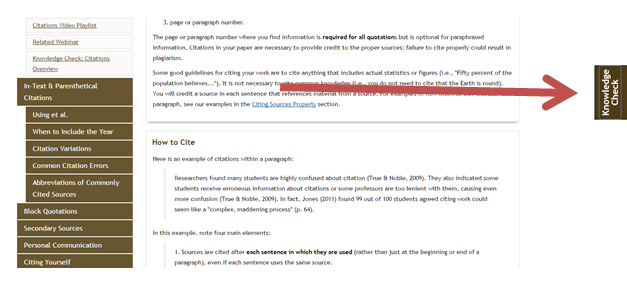
And here's what the knowledge checks itself looks like:

Here's the list of APA pages with knowledge checks--and we're adding more!
Citations Page
In-Text/Parenthetical Citations Page
Common Errors Page
Common Sources Page
Block Quotations Page
Citing Yourself Page
Personal Communication
Secondary Sources
Et al. Page
Publication Year Page
Abbreviations Page
Anthropomorphism Page
We hope you enjoy this chance to test yourself and learn more about academic writing through our webpages! Let us know how you like these checks and what you found useful below.
Never miss a new post; Opt-out at any time
Attention Walden University Capstone Writers: Introducing the New Form and Style Website
The Walden Writing Center is pleased to announce the creation of a Doctoral Capstone Form and Style Website. Because the capstone phase is a main focus of student work and the overall student process, we have tailored some of our material and interactions, as well as tips and links, specifically for students working on the proposal and beyond. The term capstone indicates a student’s major project, and includes both dissertations and doctoral studies. Here is an introduction and quick guide to the resources students and faculty will find on our new site.
 |
| Introducing the new Form and Style Website for capstone writers |
Templates. We have
included templates for the various documents involved in the different Walden
capstones (dissertations and doctoral studies).
For each degree program, we have included the appropriate (if required) premise,
prospectus, and final study template.
Along with the individual templates, we have included videos where we
explain how to use the template, such as using the table of contents, adding
new headings, and formatting the margins and page numbers.
Kits. On this page,
we present kits to help students begin writing at each phase of the capstone
process. The Preproposal Starter Kit is up
and ready on the site. In early 2017, we
will complete and present additional Kits: a Proposal Kit, a Final Study Kit,
and a Form and Style Kit. Each of these
kits will contain tips, resources, and links for students working on these
different phases of the doctoral capstone study. Watch this page for the additional kits in the
few months of 2017.
Form and Style Checklist.
This page contains the Form and Style Checklist. This is a list of the main
items and areas where Dissertation Editors focus their efforts in the Form and
Style Review. This checklist can be a
resource for students at all stages of writing.
From a tool to use while beginning writing, to a resource for
self-editing before submitting the final study, this checklist can help
students prepare and polish their capstone documents.
Top 10 Reasons for Delays. We also cover some of the main reasons for a delay of the capstone at
the Form and Style stage. Sometimes, a
study can be delayed at Form and Style or sent back for more work. See this page for more information on some of
the key aspects of the Form and Style Process and how to ensure that items
which may potentially cause a delay are addressed before submitting the
document.
Walden Capstone Writing Community (WCWC). In addition, we moved the WCWC from a
private, password-protected site onto our new Form and Style Website. Now, all students can find information about
the resources provided in the community and the live events we host. To join the community, students must have an approved prospectus and be working on the proposal. Check out this page for more information
about how to join the community and receive our newsletter.
Faculty Toolbox. This
page contains faculty-specific information about supporting students in their
writing, and requires a faculty log-in.
Information for faculty regarding Chapter Edits and how to request this
service for a student can also be found here.
Students interested in exploring the possibility of a faculty referral
for this service should encourage their chair to visit this site and review the
referral requirements.
Chat. Chat 1:1 with
an editor. Using this service, students
can get a quick question answered by one of our trained dissertation editors in
real time. Check out the schedule on the
website to find out when an editor is available to answer a question.
Other notable resources. Our new site also contains information regarding:
- Submitting to the Form and Style Review (overview and process)
- Document expectations for the Form and Style Review
- FAQ’s on confidentiality in the capstone document
- Tips for hiring a paid outside editor
We hope that students and faculty will familiarize
themselves with our new page and use these resources for students at advanced
capstone stages. Please also continue to
use the Writing Center Main Page for information on scholarly writing, punctuation, grammar
and composition, APA Style, as well as course-related and
premise/prospectus-related writing information.
.png)
Kelly Chermak is the manager of editing services in the Walden University Writing Center. She first joined the staff as a dissertation editor in 2012. She earned her PhD from the University of Minnesota in Sociology, and specializes in organization theory, workplace policy, and research methods. She is also a contributing faculty member in Walden's Human and Social Services PhD and Doctorate of Business Administration.
Never miss a new post; Opt-out at any time
WriteCast Episode 34: Taking Care of Yourself With Mindful Writing
The latest episode of the Walden University Writing Center's Podcast, WriteCast: A Casual Conversation for Serious Writers, is live. This month's episode features Beth and Brittany chatting with two very special guests, Jes and Max, about how writers can take care of themselves. In this episode, listen in on their conversation about the importance of taking time out of each day to write and how to do so in a way that helps writers make the most of their writing session each day.
Using a practice called Mindful Writing, Walden students who are so busy with careers, leadership roles, families, and other time constraints can spend a little time each day writing. Mindful Writing is designed to help make each writer's brief, daily writing session more focused, more pleasant, and more comfortable. With a more mindful writing practice, you will find that writing isn't something to dread, but rather, something to enjoy and appreciate.
Click the player below to find out more!
For a list of all of our WriteCast episodes, visit the Writing Center website for Interactive and Multimedia writing resources. Here, you can also access download information and transcripts for each of our podcast episodes. Happy Listening, WriteCasters!

The WriteCast Podcast is produced by the staff of the Walden University Writing Center and delves into a different writing issue in each episode. In line with the mission of the Writing Center, WriteCast provides multi-modal, on demand writing instruction that enhances students' writing skill and ease. We hope you enjoy this episode and comment in the box below.
Never miss a new post; Opt-out at any time
Using a practice called Mindful Writing, Walden students who are so busy with careers, leadership roles, families, and other time constraints can spend a little time each day writing. Mindful Writing is designed to help make each writer's brief, daily writing session more focused, more pleasant, and more comfortable. With a more mindful writing practice, you will find that writing isn't something to dread, but rather, something to enjoy and appreciate.
Click the player below to find out more!
For a list of all of our WriteCast episodes, visit the Writing Center website for Interactive and Multimedia writing resources. Here, you can also access download information and transcripts for each of our podcast episodes. Happy Listening, WriteCasters!

The WriteCast Podcast is produced by the staff of the Walden University Writing Center and delves into a different writing issue in each episode. In line with the mission of the Writing Center, WriteCast provides multi-modal, on demand writing instruction that enhances students' writing skill and ease. We hope you enjoy this episode and comment in the box below.
Never miss a new post; Opt-out at any time
Subscribe to:
Posts
(
Atom
)


