Providing Accessible References to Global Readers
With many changes in APA 7 focusing on the move to digital accessibility, it is important to understand the issues proxy servers can present readers and researchers. This will often require students to make modifications to DOIs retrieved from some databases, including the Walden Library databases, to ensure they are accessible to all readers. Please read below for further explanations and action items for how you can ensure the DOI numbers you include in your reference list are accessible to all readers.
A proxy server is an application that acts as a middleman between those seeking resources and those providing resources. Walden students (the seekers) are likely to see this in the databases of the Walden Library (the provider), which houses all journal articles and research that Laureate holds fair use licenses.

When including the proxy server (i.e., https://eds-b-ebscohost-com.ezp.waldenulibrary.org/doi.org/10XXXX) in the DOI provided to the reader, the writer only makes this research accessible to those with a specific login to this system. In this case, a Walden login would allow Walden students access to this research through the Walden Library databases. Instead, writers should remove this proxy server to provide the non-specific DOI (in URL form as per APA 7 guidelines) that will allow all readers, including non-Walden students, to access this specific research.
To provide the most accessible link for your reader regarding a DOI URL, eliminate “ezp.waldenlibrary.org” from the URL. It should read simply as follows: https://doi.org/10.XXXXX
Here is an example:
Inaccessible: https://eds-b-ebscohost-com.ezp.waldenulibrary.org/ doi.org/10.1080/20479700.2017.1412558
Accessible: https://doi.org/10.1080/20479700.2017.1412558
As you can see from the above example, the first link will bring the reader to a login page before allowing them to access these materials. If the reader does not have an active Walden login, they will not be able to access these materials. However, once the proxy server is removed and only the active DOI hyperlink is included, this research becomes accessible to anyone with an internet connection.
Removing the proxy information from a DOI is an important step to provide accessibility to all readers of our research, and it also aids in future accessibility as the non-proxy DOI numbers and URLs will always be accessible, even when removed from, or moved to, different internal servers.

With this rule in mind it is also important to note the recent APA 7 change that requires all DOIs to be presented in an active URL form. This may mean altering the DOI URLs you have from the Walden Library databases to follow the URL format, along with removing the proxy server information.
If you ever are unsure if you are omitting the correct information you can also check your sources on www.crossref.org/guestquery to see and verify the correct DOI URL, without any proxy server attached. You can also learn more about formatting DOI URLs on our website and through the examples on our Common Reference List Examples page.

Meghan K Barnes holds a BFA in Professional Writing & English, an MFA in Nonfiction Literature, and a MAT in Post-Secondary Adult Online Education. These degrees lead to multiple opportunities including a Fulbright Scholarship to study the nonfiction work of Sylvia Plath in England, three Pushcart Prize Nominations, and four book publications.
.png)
Never miss a new post; Opt-out at any time
October Live Webinars
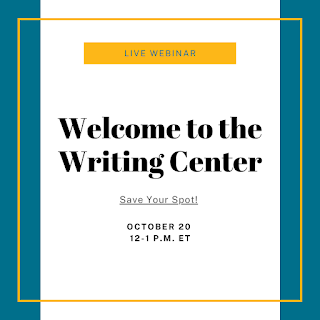


Welcome to the Writing Center
October 20, 12:00 p.m. – 1:00 p.m. ET
Register
This webinar will orient you to the many resources available at your fingertips, including paper reviews, extensive website and videos, Quick Answers, live and recorded webinars, self-paced modules, and social media. We'll specifically focus on which resources will be most helpful when you're short on time, have a few days to get help, or are looking to develop your writing skills long-term. Using Restorative Writing to Enact Social Change
October 22, 4:00 p.m. – 5:00 p.m. ET
Register

The Walden University Writing Center offers live webinars each month on academic writing topics such as scholarly writing, APA style, and practical writing skills.
Never miss a new post; Opt-out at any time
Where Do You Find Your Writing Motivation?


Beth Nastachowski Associate Director, Office of Writing Instruction.Beth Nastachowski has been with the Writing Center for 10 years and lives in Saint Paul, Minnesota.
Never miss a new post; Opt-out at any time
Writing About COVID-19
COVID-19 is inescapable for us all in the year 2020 as a pandemic that has resulted in widespread economic, social, and political consequences. As a Walden student committed to research for social change, you may find yourself interested in researching and writing on topics related to the pandemic. Here are some definitions and tips on writing about COVID-19 to provide you some initial guidance.

The World Health Organization (WHO) as an international public health leader named the disease and the virus that causes it in February 2020:
- The disease is named coronavirus disease (COVID-19).
- The virus that causes COVID-19 is named severe acute respiratory syndrome coronavirus 2 (SARS-CoV-2).
The term “COVID-19” refers to the disease caused by SARS-CoV-2. However, it also has wider application. The term is also used to refer to the pandemic resulting from widespread infections of that virus, as well as to the consequences of lockdowns and policies meant to limit the spread of COVID-19. For greater specificity, use “COVID-19” as a modifier for the specific aspect of medical, social, political, or economic consequences being addressed, as follows:
- Executive orders that prohibited public gatherings caused COVID-19 closures, resulting in the closing of local libraries. People who contract SARS-CoV-2 can have a range of COVID-19 symptoms, from little to no symptoms (asymptomatic) to severe respiratory issues.
- Following APA style guidance, look to a standard collegiate dictionary such as Merriam-Webster for spelling, which uses “COVID-19.” Note that you will see many variations on spelling and capitalization of the term in different publications, especially since the term is so new.
Although COVID-19 is an abbreviation for “coronavirus disease,” because it is listed as a term in the dictionary, it does not need to be introduced via abbreviations in your writing (see Section 6.25 in APA 7).
Other names for COVID-19 circulate fairly widely in political discussions, but many of these terms are explicitly racist and xenophobic and thus should not be used in research writing except as quotations or in discussions of the problematic nature of such terms. These names include terms such as “Wuhan virus” or “China virus” that name the location where the virus was first identified in an attempt to lay blame for the pandemic on a people, country, or government. For more information, consult the guidance issued by the United Nations (UN) on combatting COVID-19 hate speech.
For some examples of how psychology, health care, and public researchers and journalists discuss COVID-19, see the American Psychological Association’s page on APA COVID-19 Information and Resources.
As you consider different aspects of COVID-19 for research, keep in mind that as the pandemic is currently active, there is a lot of ambiguity about terminology along with heated political debate about the meanings of specific terms. Here are some examples of terms in wide circulation today that should you should carefully chose and define in your writing:
- social distancing
- quarantine, lockdown, stay at home orders, mask orders
- personal protective equipment (PPE)
- face masks, face coverings, cloth masks, respirators, N95 masks, surgical masks
As always, please email or chat with Writing Center staff if you have additional questions about how to discuss the COVID-19 pandemic accurately, clearly, and objectively in your writing.

Paul Lai, Manager, Website and Information Resources
Paul Lai manages the Writing Center's website. He lives in Minneapolis, Minnesota with his partner and their two dogs.
Never miss a new post; Opt-out at any time


