Dissertation and Scholarly Research: Simon and Goes Provide Recipes for Success (Book Review)
If you are writing a dissertation, doctoral or project
study, or any other doctoral-level capstone research project, chances are it is
the first time you have done anything of the kind. While you have years of
practice with what it means to participate in the classroom, complete
proscribed assignments, and even conduct original research, the doctoral
capstone research project is a unique document and a unique task. Why not take
advantage of any number of excellent resources available for helping you
through the various steps and stages of tackling a project of this size?
 |
| Image (c) www.dissertationrecipes.com |
Authors Marilyn K. Simon and Jim Goes have done just that, and
they just happen to be Walden faculty to boot. In their resource, Dissertation and Scholarly Research: Recipes for Success—A Practical Guide to Start and Complete Your Dissertation, Thesis,or Formal Research Project, Simon and Goes (2013) have crafted a guidebook
that addresses students working outside of traditional brick-and-mortar
institutions to complete their degrees. Their use of metaphor (specifically,
food) helps make what could otherwise seem like a dense and complex process
more, well, digestible.
The mnemonic devices, “cutting board” exercises, and links
to outside resources offer practical and accessible advice, and the guide
offers help with everything from how to formulate your research questions to
what to do when it comes time to format your document for final submission to
ProQuest.
While you could certainly sit down and read this book cover to
cover, one of the guide’s strengths is in offering a breadth and specificity of
information, so you could just refer to the table of contents and read those
sections that pertain to your current needs.
One thing that can be frustrating at times when conducting
this level of research in a virtual space is how to know where to go for the
right information and how to get a hold of who can answer your questions. This
guidebook is particularly relevant to Walden student needs in this regard
because it addresses content and design as well as APA and scholarly style. Simon
and Goes did a particularly thorough job really explaining to the reader how
everything fits together and how the way you craft and express an idea can support and inform your research.
As with any comprehensive guide, the sheer amount of
information can seem daunting at first, but everything is organized and
presented in such a way that a reader will not feel overloaded. Dissertation and Scholarly Research: Recipes
for Success should be high on the list of any Walden student looking
for that extra bit of guidance and support while beginning this next step as a
scholar-practitioner.

Lydia Lunning is a dissertation editor and the coordinator for Capstone Resources in the Writing Center. Lydia also helps oversee the Walden Capstone Writing Community, a place where doctoral students working on their proposals and final studies can connect with colleagues and get support through the capstone writing process. Outside of Walden, Lydia enjoys literature for children and young adults, writing pedagogy, contemporary cinema, and cooking.
Get new posts in your email inbox!
|
Defining a Gap in the Literature: On Proving the Presence of an Absence
It’s standard in any study to point out the gap in the
literature you're seeking to fill. (Else why do the study—unless it’s a
replication study?) Like the hole in the donut, the gap is defined by what surrounds
it. Yet it’s common to read statements in the literature review such as (a) “I could
not find anything on [the issue] in the literature” or (b) “Very few studies,
if any, talked about [the issue].”

It’s not easy to prove a negative: This does not exist. Therefore, to define a gap, a precise and
exhaustive search is needed to identify all the studies around—but not
touching—your topic. Reporting what you did find, what is known (the donut) implies
what is not known (the hole in the
donut). The unknown is the gap, your topic.
The problem with (b) is that it leaves readers wondering
about what you know; it asks them to just accept your claim with no support. If
your search were thorough, you would know whether any or just a few studies
talked about your issue. If there were none, then, just as in (a), you’d define
the gap by identifying the studies around—but not touching—your precise topic. The
number of studies required to make that point could vary. However, if there
were some studies, then you'd need to
discuss only those studies in order to confirm for your readers that something was
indeed missing—your angle on the
issue.
If your search was precise—if you named all the databases you used (not just the names of portals, such as ProQuest or EBSCO), if you listed all the keywords (not phrases) you used, and if you specified your time range—then your committee (and future readers) could have confidence that you were in the right ballpark. If you then described what was known—using a broad set of studies or a handful of specific studies—then your readers could have confidence in your claim because they could see your process, and judge the data adduced, to “prove” a negative and reveal the presence of an absence.
If your search was precise—if you named all the databases you used (not just the names of portals, such as ProQuest or EBSCO), if you listed all the keywords (not phrases) you used, and if you specified your time range—then your committee (and future readers) could have confidence that you were in the right ballpark. If you then described what was known—using a broad set of studies or a handful of specific studies—then your readers could have confidence in your claim because they could see your process, and judge the data adduced, to “prove” a negative and reveal the presence of an absence.

Tim McIndoo, who has been a dissertation editor since 2007, has more than 30 years of editorial experience in the fields of medicine, science and technology, fiction, and education.
Get new posts in your email inbox!
|
A Match Made in Heaven: Reference Entries and Citations in APA
To me, knowing how and why rules apply to me always makes them
more relevant and makes me more inclined to learn and use them. This approach makes sense when talking about APA Style because APA rules can seem so
arbitrary. So, with the approach of helping students understand the reasoning
behind the APA rules, let’s start at the beginning: the reference list.
What is a reference list?
The
reference list is the foundation for citing sources in APA. In APA, writers
include all sources they use within the body of the paper, but only those sources, in the reference
list. This is a little different from a works cited or bibliography (lists of
sources used in other citation styles, like MLA and Chicago),
which sometimes include sources the author consulted but did not end up using
in the paper.
In APA, if you cite a source anywhere within the paragraphs
of the paper, it should also appear in the reference list. Similarly, only
sources used within the body of the paper are included in the reference list.
It’s always a good idea to proof for this relationship before finishing your
paper. If you take just one thing away from this post, remember this: Every source cited in your paper must have an entry in the reference
list, and your reference list should not contain any sources that you didn’t
cite in your paper. This rule applies for almost
every source you cite in-text. The only exception to this rule is personal communication citations, which do not have corresponding entries in the reference list.
What is its purpose?
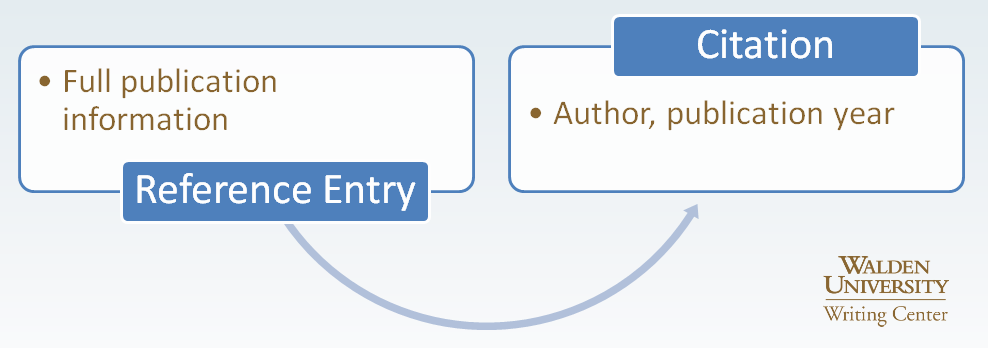
The reason you need to list all of the sources you cite in the body of your paper in the reference list is so the reader can trace the information you used to inform your writing. Imagine that you incorporate a statistic regarding high school graduation rates in your paper; you include a citation to your source in the sentence that uses the statistic. The reader could then use that citation to find that source and its full publication information in your reference list, allowing the reader to find the source itself.
This function of the reference list is also why citations
are structured the way they are. Because sources are listed alphabetically by
author in the reference list, citations include the author(s) of a source and
the source’s publication year.
How do you create reference entries?
Because the purpose of the reference list is to help
the reader track the sources you used, a reference entry must include enough
information for the reader to find the original source. This includes the
following basic information:
- Author(s) of the source
- Publication year of the source
- Title of the source
- Publication information of the source

Check out these great resources to help you create reference entries:
- Common Reference List Examples page on our website
- Recordings of the APA Citations webinar series
- APA Style Blog
And, of course, if you ever get stuck creating a reference
entry, simply let us know via e-mail at writingsupport@waldenu.edu.
Now that you know the reasoning behind a reference list and
how it relates to the in-text citations in your writing, I hope you’ll have a
better understanding of why the
reference list is so important.

Beth Oyler is a Writing Instructor and the Webinar Coordinator for the Writing Center. She lives in Minneapolis and recently graduated with her MA in English.
Get new posts in your email inbox!
|
Who Needs a Writing Buddy? You Do!
Work, family, cleaning, exercise, the latest World Cup game—every day brings countless responsibilities and distractions that get in the way of writing. Writing takes time, and it can be hard to stay motivated and easy to find another day slipping by without another word on the page.
If this sounds familiar, what you need is a writing buddy. Your buddy is someone who checks in with you periodically, perhaps once a month, once a week, or even every day, to hold you responsible for pursuing your writing goals. The idea is that if you share your writing goal with another person who commits to checking in with you on that goal, you’re more likely to stay on track. Having a writing buddy or buddies can also help you feel connected with a writing community.

If this sounds familiar, what you need is a writing buddy. Your buddy is someone who checks in with you periodically, perhaps once a month, once a week, or even every day, to hold you responsible for pursuing your writing goals. The idea is that if you share your writing goal with another person who commits to checking in with you on that goal, you’re more likely to stay on track. Having a writing buddy or buddies can also help you feel connected with a writing community.
WriteCast Episode 10: Faculty Writing Advice: Interview With Dr. JaMuir Robinson


This month's WriteCast episode features a faculty interview from the Atlanta residency in April. Nik speaks with Dr. JaMuir Robinson, faculty member in the School of Health Sciences, about her writing advice for students. Also in this episode, Brittany explains her role as the coordinator of Writing Center residency instruction and design.
Subscribe to:
Posts
(
Atom
)


